

Sensory Design
through the senses

portada artículo diseño sensorial

Project – Exhibition on the relationship between the senses and design.

"We are all instruments endowed with feeling and memory. Our senses are strings struck by surrounding objects and also frequently struck by themselves.. – Denis Diderot

Introduction

We live in an environment connected to our senses. Likewise, whether it be sight, touch, smell, taste, or hearing, all of them are involved in that amalgamation of feelings that human beings possess.

What will we see at the exhibition?

In this exhibition we will try to explore and experience sensory design by traveling through each of the senses by means of a journey from the beginning to the end of the installation.

It will feature 5 roomsbut each one dedicated to a single one of the five senses. Each room will also correspond to a color. To assign colors to the senses, we will base them on the influence they have on each other, so, first, for the view We have red, which conveys serenity and enhances awareness of the "here and now." Then, for the ear We have yellow. When we close our eyes, our auditory capacity is enhanced; it's associated with the element of air and can "shed light" on our experience. Subsequently, the touch We will associate it with violet, linked to the higher level of consciousness and spirit. Later, for the taste We will assign the color blue, which is a flavor enhancer when used to solarize water. Finally, for the smellThe aromas indicate that changes are occurring as a result of the exchange of energies. It is associated with the color green and evokes experiences of chromatic associations.

How will it be distributed?

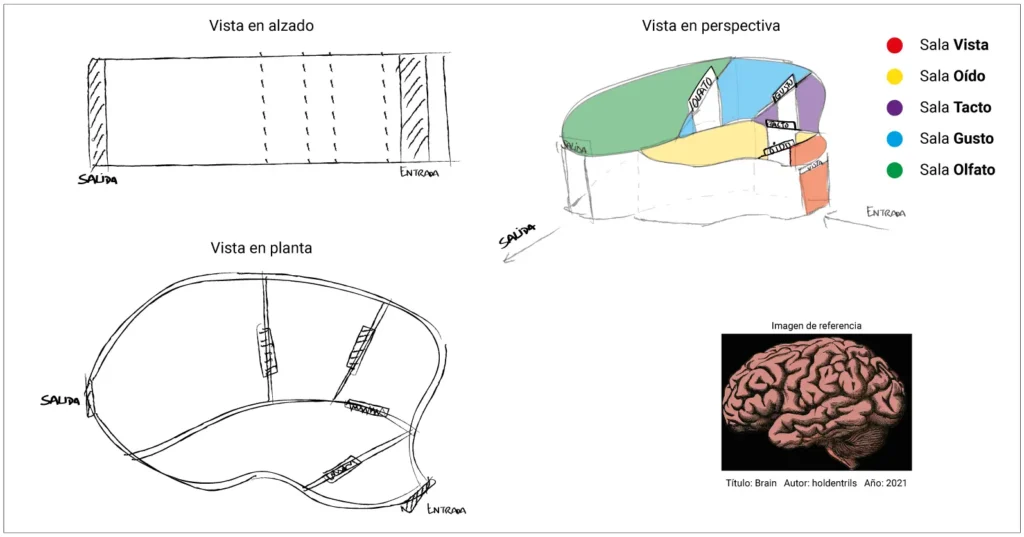
The exhibition layout It will be based on the different locations of the senses in the brain, but by zones; that is, from a plan view of the general room, the outline of the brain seen from its side would be visible (Figure 1To access most of the rooms, you will need to do so in an original way, using the relevant senses to enter. This aims to amplify the experiential aspect for visitors and enhance their enjoyment of the visit. We will explore this in more detail in the text for each room. Throughout the exhibition, we will see how sensory design has evolved over time, using images, illustrations, objects, lighting, and more to illustrate this.

boceto estructura de la exposición de diseño sensorial
Sketch of the views of the general installation. Source: Own elaboration.
Statement

The theme of the exhibition is indicated by «Sensory design through the senses"Without a doubt, we live in a highly developed, digitalized era. This, for better or for worse, depending on one's perspective—but all perspectives are valid—is helping to invent new ways of perceiving reality and to experience new sensations. I believe that our senses and design are yet to develop even further together. What truly excites me about all this is that sensory design has countless applications, from living room lighting that stimulates your mood to air cabins that simulate gravity in space."

From a young age, I've felt an enormous curiosity about how and what things are made of. Likewise, depending on the form or function of objects/products, they can change lives or even generations. New ideas for experimenting with the senses are constantly being created and developed, which is why this exhibition aims to show how our senses are affected, both consciously and unconsciously, in every aspect of our lives.

Sign at the entrance to the exhibition:

"Experience is a necessary condition for knowledge, and the nature of experience depends on the qualities to which it refers; therefore, the quality of experience will depend on what our senses have access to and how we are able to use them.«. – Eisner


Text for the View Room

Firstly, the senses that are most important when it comes to stimulation are sight, hearing and touch, and sensitivity, both superficial and deep (Velasco & Muñoz, 2003In this room, you can stimulate your sense of sight with the help of tools such as reflectors, varying lighting and colored lights, mirrors that recreate sensations of the outside world, or virtual reality glasses with which you will experience a new perception of the world.

Text for the Ear Room

Absolute silence doesn't exist. Why? Because even if we were alone in the quietest place on Earth, we would still hear our nervous system through the impulses of our heartbeat or the sounds of our joints. Furthermore, we can create melodies with our body parts based on our movements. Likewise, there are truly fascinating instruments that offer extraordinary sonic experiences.

Text for the Touch Room

When things come into contact with an individual, they become part of their experience, connecting them to a space and time. Sometimes, objects move and stir us, helping individuals to situate themselves both outside and within themselves. An object is the potential for an experience, and therefore, designed objects also possess this purpose. A series of multisensory objects is proposed, offering alternative experiences and sensations through touch and movement. Blindfolds will be available in some sections to enhance the experience.

Text for the Taste Room

The aestheticization of food and drink is growing, especially in a hyper-consumerist and modern society. Likewise, aesthetics are paramount when it comes to innovation in the culinary arts and the search for new creations. Consequently, the environmental and sensory experience in appropriate spaces cannot be overlooked. We will show how it is possible to experience food tasting in a new way.

Text for the Smell Room

Finally, our sense of smell awakens sensations and emotions in people, such as relaxation, stress, and well-being, but we rarely use it to create new experiences and applications. Aromas can transport us to places and horizons we couldn't imagine if we weren't there. Blindfolds will be available to enhance the experience.

Sources:

Calvera, A. [Anna]. (2007). De lo bello de las cosas: materiales para una estética del diseño (Págs. 8-30). Editorial Gustavo Gili. https://ebookcentral.proquest.com/lib/bibliouocsp-ebooks/reader.action?docID=3209629&ppg=8

TED (2013, 6 de agosto). Jinsop Lee: Diseños para los 5 sentidos [vídeo en línea]. Youtube. https://www.youtube.com/watch?v=N6wjC0sxD2o

Morales González, E. [Elia del Carmen ]. (2015). Conceptuación y desarrollo del diseño sensorial desde la percepción táctil y háptica. Tesis doctoral no publicada. https://riunet.upv.es/handle/10251/53027

Gilles Lipovetsky , J. S. [Jean Serroy]. (2014). Mundo diseño. La estetización del mundo (Págs. 188-207). Editorial Anagrama. https://ra.biblioteca.uoc.edu/prestatgeries/

articles/protegits/M3374_M3674/91154

Gilles Lipovetsky , J. S. [Jean Serroy]. (2015). ¿Estetización o empobrecimiento del consumidor?. En: La estetización del mundo. (Págs. 279-292). Editorial Anagrama. https://ra.biblioteca.uoc.edu/prestatgeries/

articles/protegits/M3374_M3674/91152

Carbajo Vélez, M [Maria del Carmen]. (2014). La sala de estimulación multisensorial. Universidad de Valladolid. https://core.ac.uk/download/pdf/211100288.pdf

Sensorama. 2021. www.sensorama.mx

ArtNexus. 2019. www.artnexus.com https://www.artnexus.com/es/magazines/article-magazine-artnexus/5d64034090cc21cf7c0a341b/85/the-tongue-ofernesto-

1987-2011-works Visible Body. 2021. www.visiblebody.com https://www.visiblebody.com/es/learn/nervous/five-senses

Medico+. 2021. medicoplus.com https://medicoplus.com/neurologia/como-funcionan-nuestros-sentidos

Borja de Mozota, B. [Brigitte]. (2006). El diseño de la innovación, dos retos para la profesión del diseño, (132-146). https://www.raco.cat/index.php/Temes/

article/view/51784/104097

Wikipedia. 2021. es.wikipedia.org https://es.wikipedia.org/wiki/Cromoterapia

Todos somos uno. 2012. Todossomosuno.com https://todossomosuno.com.mx/portal/los-colores-y-los-sentidos/

Keuco. 2020. www.keuco.com https://www.keuco.com/gq/productos/espejos_con_luz/

Microsoft (2001, 1 de octubre). The quietest place on Earth? | Microsoft Story Labs [vídeo en línea]. Youtube https://www.youtube.com/watch?v=Cyqc_4ixV80&t=207s

IMAX. 2021. www.imax.com https://www.imax.com/es/content/imax-difference

BBC. 2021. www.bbc.com https://www.bbc.com/mundo/vert-cul-55520447

Proartso (2014, 5 de marzo). Exposición artística Multisensorial CCCB [vídeo en línea]. Youtube https://www.youtube.com/watch?v=JlYhHguhSD4&list=PLgUSsEZUjmytc

Cy9AIQ9F2MuUvmywp1oY&index=7

Salud digital. 2018. www.consalud.es https://www.consalud.es/saludigital/118/un-guante-para-percibir-el-sonido-a-traves-del-tacto_52436_102.html

TEDx Talk (2016, 30 de junio). Architecture and the Science of the Senses | Stefan Behling | TEDxGoodenoughCollege [vídeo en línea]. Youtube https://www.youtube.com/watch?v=FbfPWalO_ss&list=WL&index=27

TED (2013, 6 de agosto). Jinsop Lee: Diseños para los 5 sentidos [vídeo en línea]. Youtube https://www.youtube.com/watch?v=FbfPWalO_ss&list=WL&index=27